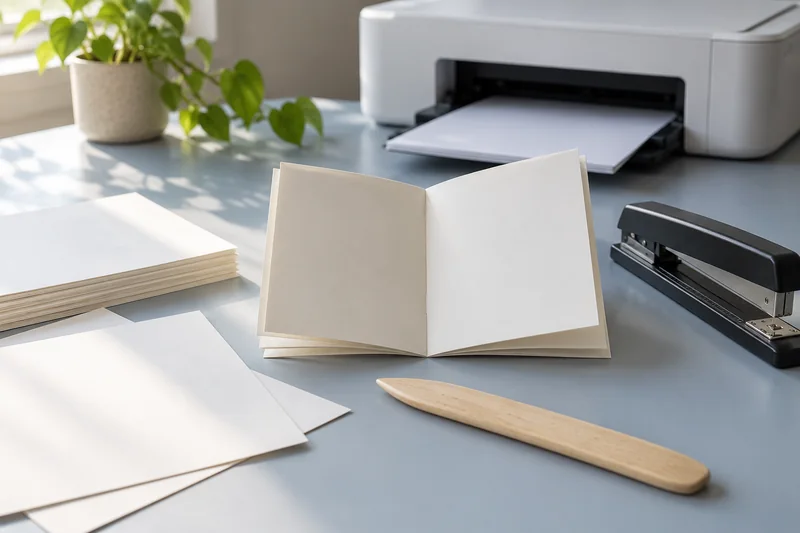
Answer: Make a small numbered proof, fold it as intended and read every page in sequence. Booklet imposition, duplex turning and page scaling are separate settings.
On this page
Print Use Lab editorial project · Updated October 21, 2026 · Original decision framework and illustrative example. No physical product measurement or hands-on benchmark is claimed.
Why the distinction matters
A booklet places pages out of reading order on the flat sheet so they become sequential after folding. Ordinary two-pages-per-sheet printing does not necessarily do that. Decide the finished page size and binding before choosing the application mode. Check whether your PDF already contains imposed spreads; imposing it again can scramble the layout. Keep a copy of the original document.
A practical sequence
- Identify whether the file contains single reading pages or already imposed sheet spreads.
- Use the application’s appropriate booklet or imposition workflow for that file.
- Print a short numbered proof on supported plain paper and fold it.
- Check page sequence, upright backs, margins and content near the fold before printing the run.
Decision record
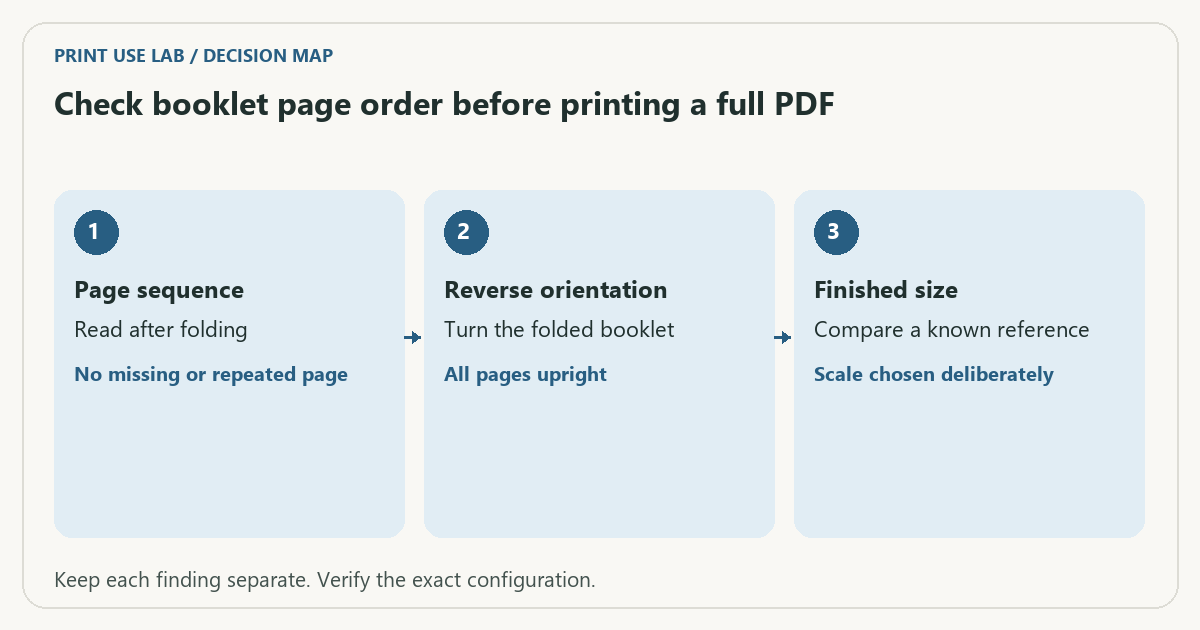
| Check | What it means | What to verify |
|---|---|---|
| Page sequence | Read after folding | No missing or repeated page |
| Reverse orientation | Turn the folded booklet | All pages upright |
| Finished size | Compare a known reference | Scale chosen deliberately |
Worked example
For an illustrative eight-page booklet, one outer sheet face pairs pages 8 and 1, while its reverse pairs 2 and 7 in the appropriate orientation. Reading the flat sheet as if it were a normal document will look wrong. Folding the proof reveals whether the imposition and turning actually work together.
Verify the result
Keep the successful proof beside the printer until the job is complete. Include any blank pages required by the intended imposition. For dimension-sensitive work, verify the printed scale as well as the reading order.
Download the editable CSV worksheet · Print-job workbook
Question and answer
Can I use two pages per sheet instead of booklet mode? Only if the source is already arranged for that result. Ordinary N-up layout and booklet imposition solve different ordering tasks.
Sources and scope
- Adobe Acrobat: page sizing for print — Distinguishes scaling modes. Printer margins and supported media remain model-specific.
The decision sequence, diagrams, worksheet and worked case are our editorial work. AI assisted research, drafting and implementation. Official references support the named technical distinctions; examples do not establish real product performance.
Continue the task
- Printable area vs paper size: diagnose cropped edges
- Actual size or Fit? Choose PDF print scaling by the job
- Browse the complete resource library
Build on what you just learned
Your next useful step.
Proof the page, binding edge and reading order.
A filled PDF prints blank fields: check the saved file and print layers
Save and reopen the filled PDF, then inspect the print preview and the viewer’s form/comment options.
Read the guide →Duplex printing: automatic, manual and binding-edge differences
Automatic duplex prints both sides without asking you to reload the sheet. Manual duplex requires a documented reinsertion step. Neither feature tells you whether…
Read the guide →