Answer: Divide the job’s included costs by useful retained output. Rejected sheets and reprints consume supplies even though they do not become deliverables.
On this page
Print Use Lab editorial project · Updated October 21, 2026 · Original decision framework and illustrative example. No physical product measurement or hands-on benchmark is claimed.
Why the distinction matters
A cost-per-printed-side estimate can look attractive while the finished job has a high reject rate. Define a reject before the run: wrong layout, unacceptable banding or an accidental extra copy. Keep proofs separate from production when useful. Do not assume the same reject rate for every document or printer; measure it for the actual job and retain the reason codes.
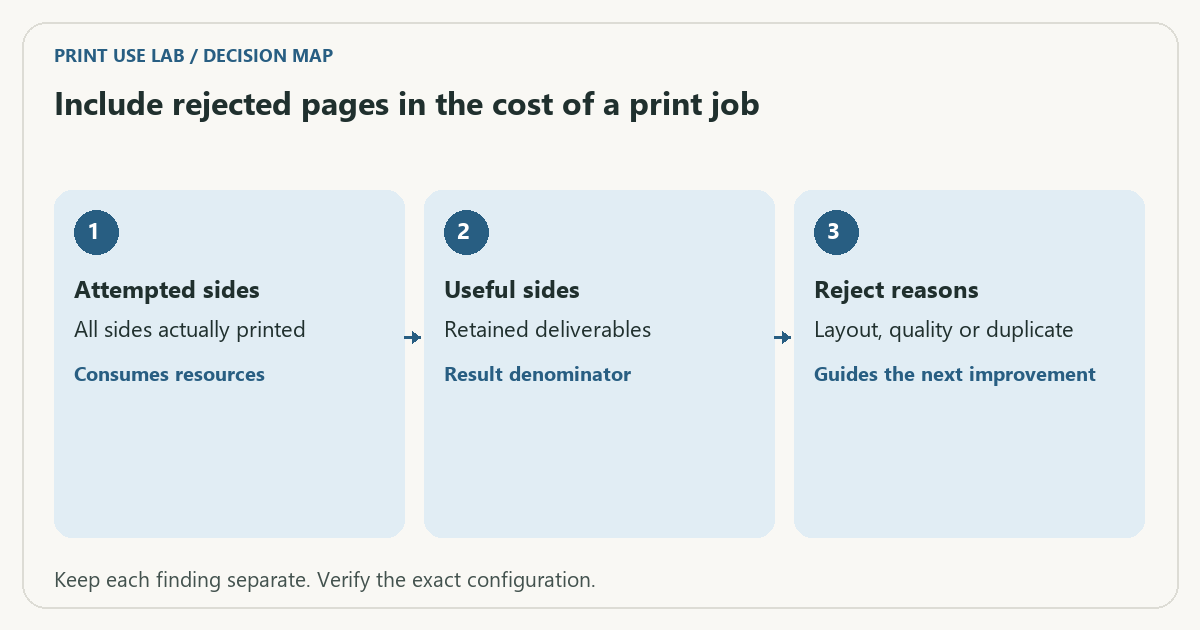
A practical sequence
- Define what counts as a usable deliverable for the job.
- Record attempted sides, retained sides and rejected sides with reasons.
- Include the costs you intend to measure, naming paper and supply layers separately.
- Calculate cost per retained side and compare with the pre-job estimate.
Decision record
| Check | What it means | What to verify |
|---|---|---|
| Attempted sides | All sides actually printed | Consumes resources |
| Useful sides | Retained deliverables | Result denominator |
| Reject reasons | Layout, quality or duplicate | Guides the next improvement |
Worked example
An illustrative run attempts 110 sides to deliver 100 useful sides. If included costs total $5.50, the finished cost is $0.055 per useful side. Dividing by 110 gives $0.05 per attempted side, a different metric. Correcting a layout mistake before the full run can be more valuable than a small supply-price saving.
Verify the result
Use one proof before a large batch and keep the verified settings. Compare supply systems using the same useful workload and ownership horizon. A low nominal ink cost does not compensate for a workflow that cannot produce the required result.
Download the editable CSV worksheet · Print-job workbook
Question and answer
Is reject rate rejects divided by useful pages? State the denominator. A common job rate is rejected attempted sides divided by total attempted sides; extra attempts per useful side is a different quantity.
Sources and scope
- Brother USA: toner yield not as expected — Declared yields and actual usage differ. Example costs here are invented planning inputs.
The decision sequence, diagrams, worksheet and worked case are our editorial work. AI assisted research, drafting and implementation. Official references support the named technical distinctions; examples do not establish real product performance.
Continue the task
- Tank vs cartridge inkjet: when the extra upfront cost makes sense
- Compare home printing with a copy shop using the same job
- Browse the complete resource library
Build on what you just learned
Your next useful step.
Compare supplies, volume and rejected pages.

Epson EcoTank ET-2950: a sensible shortlist for regular mixed home printing
I would shortlist the ET-2950 for a household that prints colour documents regularly and wants automatic A4 duplex printing with refillable tanks.
Read the guide →Cost per page methodology: yields, color and ownership costs
Begin with the supplies price divided by the matching declared yield, then explain the scope. That quotient is a planning baseline, not a promise…
Read the guide →