Answer: Compare the full cost of equivalent useful output over a stated period. Include purchase and time assumptions explicitly instead of comparing a supply-only estimate with a shop’s finished price.
On this page
Print Use Lab editorial project · Updated October 21, 2026 · Original decision framework and illustrative example. No physical product measurement or hands-on benchmark is claimed.
Why the distinction matters
A shop quote can include paper, finishing and a particular turnaround, while a home estimate may include only ink. First align page size, color, stock, duplex, finishing and quantity. Then decide whether you are comparing an additional job on a printer already owned or a new printer purchase. That changes which fixed costs belong in the decision.
A practical sequence
- Write a common job specification and obtain an actual dated quote for that specification.
- Model home supplies, paper, rejects and any required finishing.
- Add purchase cost only when it belongs to the decision being made.
- Calculate low and expected volume cases and consider turnaround and handling time separately.
Decision record
| Check | What it means | What to verify |
|---|---|---|
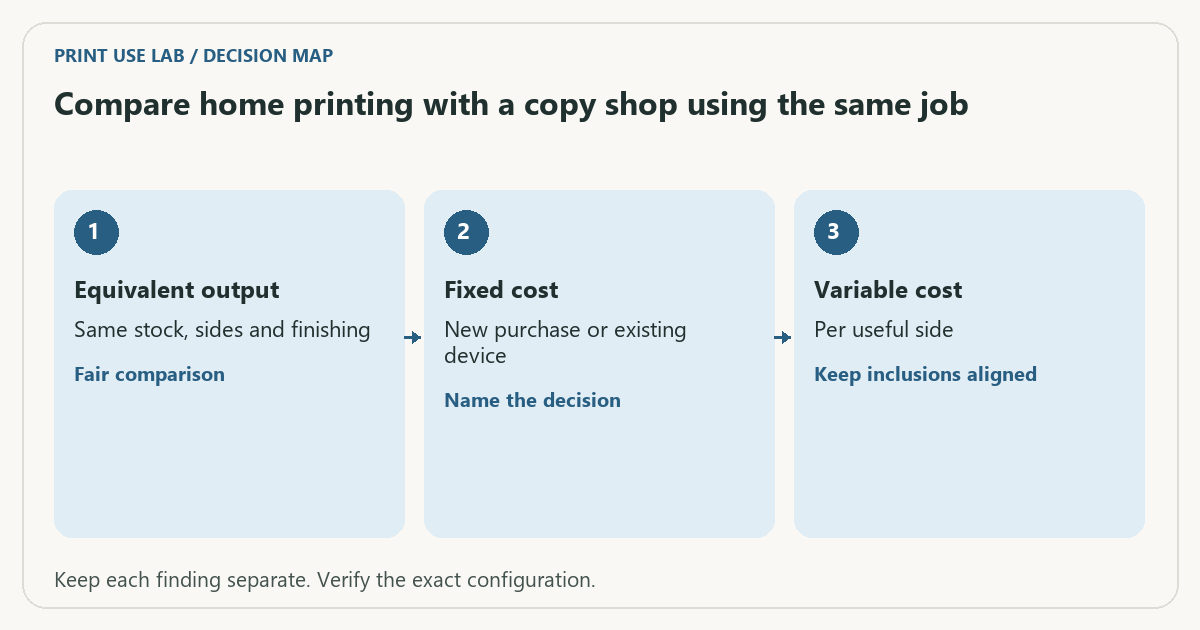
| Equivalent output | Same stock, sides and finishing | Fair comparison |
| Fixed cost | New purchase or existing device | Name the decision |
| Variable cost | Per useful side | Keep inclusions aligned |
Worked example
With invented inputs, a $180 new printer and $0.06 variable home cost compete with a $0.12 shop price. Ignoring other differences, the crossing point is $180 ÷ ($0.12 − $0.06) = 3000 useful sides. If the printer is already owned and not being replaced, that purchase calculation answers a different question.
Verify the result
The crossing point is a model, not a product recommendation. Obtain current local prices before spending. A home printer that lacks the required media or finishing cannot win the job on cost alone.
Download the editable CSV worksheet · Print-job workbook
Question and answer
Should travel time be converted into money? You can add a stated personal time value or show minutes separately. Keep the assumption visible rather than presenting it as a market rate.
Sources and scope
- Brother USA: toner yield not as expected — Declared yields and actual usage differ. Example costs here are invented planning inputs.
The decision sequence, diagrams, worksheet and worked case are our editorial work. AI assisted research, drafting and implementation. Official references support the named technical distinctions; examples do not establish real product performance.
Continue the task
- Inkjet vs laser: choose by the pages you print
- USB printing works but scanning fails: check the separate workflow
- Browse the complete resource library
Build on what you just learned
Your next useful step.
Compare supplies, volume and rejected pages.
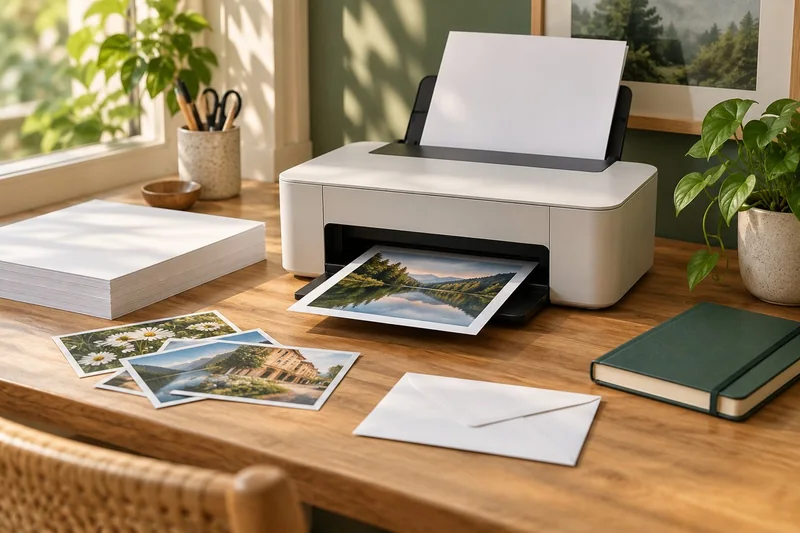
Epson EcoTank ET-2950: a sensible shortlist for regular mixed home printing
I would shortlist the ET-2950 for a household that prints colour documents regularly and wants automatic A4 duplex printing with refillable tanks.
Read the guide →Cost per page methodology: yields, color and ownership costs
Begin with the supplies price divided by the matching declared yield, then explain the scope. That quotient is a planning baseline, not a promise…
Read the guide →