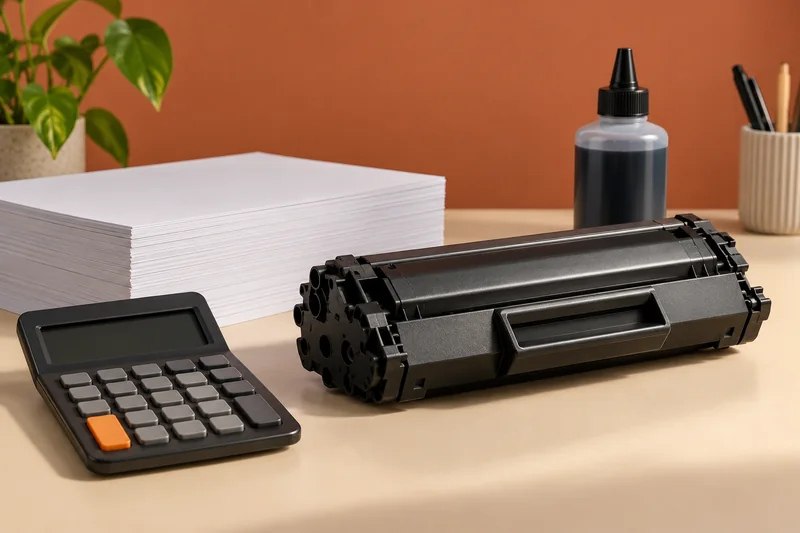
Answer: Retain the declared yield’s test conditions and supply type. Real document mix, setup and operating conditions can change the number of useful pages produced.
On this page
Print Use Lab editorial project · Updated October 21, 2026 · Original decision framework and illustrative example. No physical product measurement or hands-on benchmark is claimed.
Why the distinction matters
A yield is not a promise that every cartridge will print that many of your own pages. Separate starter supplies, replacement supplies and any subscription allowance. A dense presentation, photo and short letter do not impose the same task. Avoid a universal multiplier based only on a guessed coverage percentage because printer behavior and the yield method can add other effects.
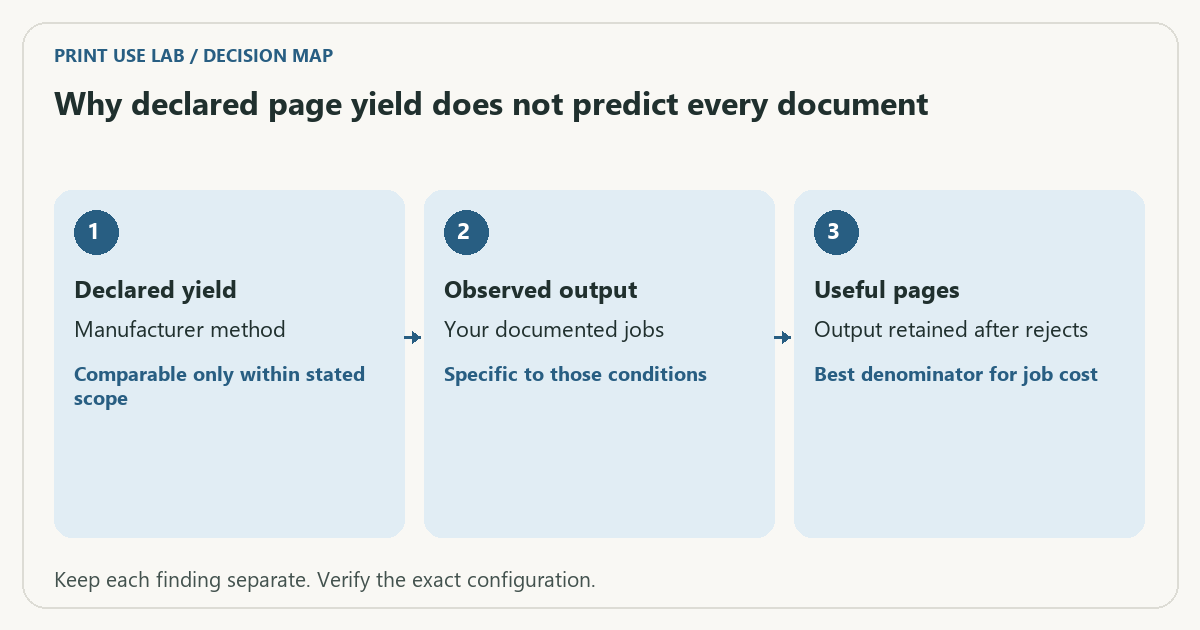
A practical sequence
- Record the exact supply code and whether it is a starter or replacement item.
- Keep the manufacturer’s yield method and footnotes with the value.
- Track your document mix and useful output over a meaningful usage period.
- Use declared and observed costs as separate rows rather than replacing one silently.
Decision record
| Check | What it means | What to verify |
|---|---|---|
| Declared yield | Manufacturer method | Comparable only within stated scope |
| Observed output | Your documented jobs | Specific to those conditions |
| Useful pages | Output retained after rejects | Best denominator for job cost |
Worked example
A fictional $60 supply with a declared 3000-page yield gives $0.02 per declared page before paper and other costs. If a recorded period produces 2400 useful sides for that supply expense, the observed supply cost is $0.025 per useful side. Those different denominators should be named, not averaged together.
Verify the result
Do not use document yield as a count of full-page photographs. Keep dates and currency with prices. If output is unexpectedly low, follow the manufacturer’s support procedure with the supply identity and job history.
Download the editable CSV worksheet · Print-job workbook
Question and answer
Can I compare two yields without checking the method? The values may describe different supplies or conditions. Retain the methods and scope before using them in a comparison.
Sources and scope
- Brother USA: toner yield not as expected — Declared yields and actual usage differ. Example costs here are invented planning inputs.
The decision sequence, diagrams, worksheet and worked case are our editorial work. AI assisted research, drafting and implementation. Official references support the named technical distinctions; examples do not establish real product performance.
Continue the task
- Starter toner vs replacement yield: compare printing costs fairly
- Separate toner, drum and maintenance-part costs
- Browse the complete resource library
Build on what you just learned
Your next useful step.
Compare supplies, volume and rejected pages.
Epson EcoTank ET-2950: a sensible shortlist for regular mixed home printing
I would shortlist the ET-2950 for a household that prints colour documents regularly and wants automatic A4 duplex printing with refillable tanks.
Read the guide →Cost per page methodology: yields, color and ownership costs
Begin with the supplies price divided by the matching declared yield, then explain the scope. That quotient is a planning baseline, not a promise…
Read the guide →